
At an altitude of nearly nine hundred and fifty meters, within the dormant crater of an ancient volcano, this dead lake was born in a perfectly circular form; Saint Anne—brimming with rainwaters. Only schools of thriving, healthy catfish make this their home. Bears sway out from deep within the pine forest, bypassing human tracks, to drink from these crystal-clear waters.
Next to the lake lies a flat marshland, a damp, soft expanse of terrain where people rarely come. Now: a winding pathway made of wooden planks lies sprawled across the marshland.
It is also called the Lake of Moss, and as for the water, legend has it that it never freezes, for the heart of the lake remains perpetually warm—even though the volcanic crater has lain dead for thousands of years. The sullen silence of centuries perpetually crouches over this desolate expanse.
An ideal place indeed—one of the art camp's organizers had commented on the very first day while showing the arriving artists and poets around—; a fitting site to remain immersed in intricate thoughts, of course, and the finest for wandering, with green, fresh breezes blowing continually; no one made the mistake of failing to take advantage of this pleasant opportunity.
Near the camp stood a mountain whose peak rose a thousand meters high. On both tracks—the ascent and the descent—there was quite a crowd of wayfarers; that did not mean exciting things were not underway at the art camp. Brimming with vitality, everyone immersed themselves with ever greater vigor, enthusiasm, and creativity; time slipped by as it was wont to do; and their creative intentions, nourished by the grace of this place, gradually brought aesthetic works of art from imagination into concrete reality.
Everyone settled into their allotted spaces in the camp, arranging things to their liking. Most took private rooms in the main building, while some deliberately gathered in the old wooden shacks or long-abandoned huts. Three of them lodged in the vast attic room of the main building at the center of the camp; in this manner, each had designated their own contemplation podium. Needless to say, uninterrupted solitude is the most coveted thing during intellectual work.
Work went on smoothly in that serene spirit, and the days drifted by to that very rhythm—working most of the time, spending the rest on walks, a pleasant dip in the lake, delicious meals, and gathering around the campfire in the evenings with homemade brandy in hand, singing one's heart out.
Yet using such ordinary subjects and descriptive cadence in this story was, in truth, a misstep; for slowly, but with absolute certainty, it came to light—something the keen observers had sensed on the very first day, and which had established itself among the rest by the third morning—that in this group of twelve, there was one of an entirely different mold. His very arrival was like a dark mystery in itself, or at the bare minimum, this much was certain: he had not arrived here like the others—neither by train, nor by bus!
On the day he arrived, around six or six-thirty in the evening, everyone saw that the man suddenly entered on foot through the camp gate, as if he had just walked straight in from somewhere, and, looking at everyone’s curious eyes, offered merely a nod in greeting.
The organizers initially sought his name, address, and identity with due respect, but the man's indifferent silence compelled them toward a more pressing interrogation. To satisfy their curiosity regarding his arrival, he offered a perfunctory reply—someone had dropped him off in a car at the road junction. Yet across this vast, enveloping silence, no one had heard the sound of any vehicle that could have set him down at the bend in the road!
Therefore, this notion—that he had indeed arrived in a car, yet that car had not traveled the entire way, but only up to a certain bend in the road, whereupon he got out and walked the rest—seemed quite incredible; no one truly believed him—or more precisely, no one could make sense of his covert remarks. Thus, from that very first day, the only plausible, the only rational—yet simultaneously the most absurd—possibility hung in the air: he had walked the entire way.
A journey begun from Bucharest: boarding neither train nor bus, but walking continuously on foot—who knows for how many weeks—crossing that ever-lengthening road to arrive at the gates of the art camp by Lake Saint Anne around six or six-thirty in the evening was this stranger. When asked whether the organizing committee had the honor of welcoming Mr. Ion Grigorescu, he once again offered no more than a curt, affirmative nod of his head.
Looking at his shoes, of course, the possibility did not seem quite so improbable. The pair had likely been brown once—lightweight synthetic loafers meant for summer, the stitched patterns over the toe caps long frayed apart, the battered and torn leather threatening to crumble into pieces around his feet. The soles hung loose, the heels were worn entirely flat, and near the little toe of his right foot the leather upper was torn obliquely, laying bare the sock beneath.
Everything about him remained a mystery to the end, for it was not merely his shoes; his attire too set him distinctly apart from the Western or Westernized clothes worn by the others. From the look of his clothes, it appeared our friend had stepped straight out of the Ceaușescu era—that time of poverty and desolation in the late eighties—time-traveling abruptly into the present tableau.
The faded, baggy trousers, made of some thick flannel-like cloth, hung indifferently above his ankles; and more agonizing still was his impoverished, sagging cardigan—draped over a check shirt of a dull, mossy green as heavy as despondency itself, buttoned up to the throat despite the summer heat.
Slight of build like a waterfowl, with hunched shoulders and an expanse of a bald head, his grotesque, weathered countenance harbored two dark brown, unblemished eyes that burned—two pure, blazing eyes—burning not with inner fire, but standing like twin still mirrors, reflecting the burning things outside.
By the third day, everyone came to see that the art camp held little significance for him. He produced no work, nor did he indulge in what people usually do on a summer vacation—swimming, trekking up the mountains, fishing, or any of the other pleasures people generally pursue at art camps of this kind.
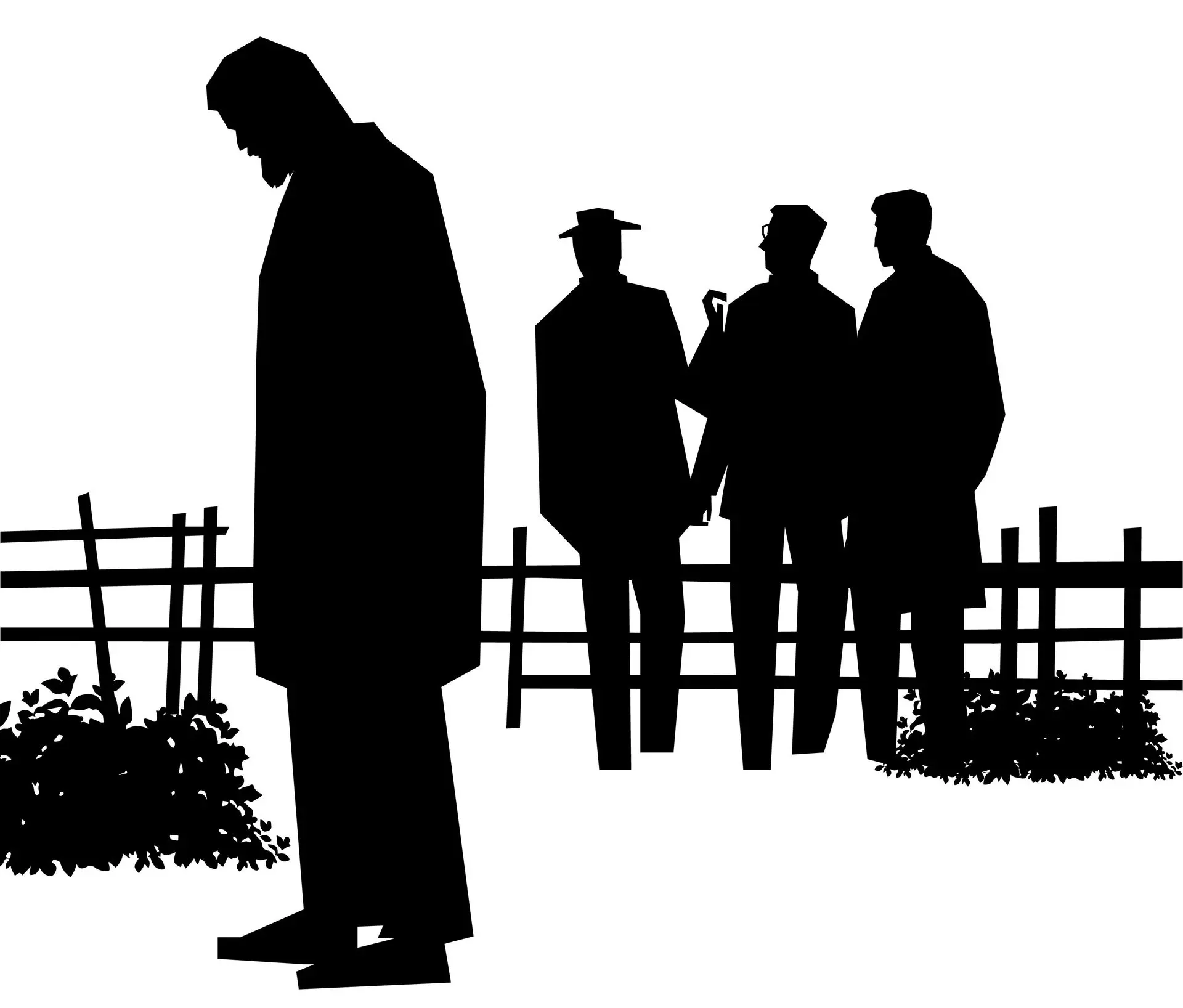
He had asked the organizers for a pair of shoes (they had found a pair of boots hanging from a nail in the storeroom). Wearing those boots, he wandered about within the camp all day long, never stepping beyond the camp's boundaries—neither climbing up the mountain, nor descending, nor strolling around the lake; he was never even seen walking along the planked wooden path over the moss-covered smaller lake. He simply paced back and forth around the camp, watching what the others were working on, with access to every room of the main building.
He would come up silently behind the painters, printmakers, and sculptors, stopping to watch with deep attention how an artwork evolved day by day; he would ascend to the attic, visit the shed, and wander into the wooden shack—yet he spoke to no one, nor did the slightest sound escape his lips in answer to any question, as if he were deaf and mute, or as though he could not fathom what was being asked of him; completely noiseless, detached, emotionless—like a ghost, like a tree; and as all eleven of them began to take notice of him (just as Grigorescu, too, was observing them), they arrived at a realization.
That evening, they were sitting around the campfire chatting among themselves (Grigorescu was never seen at these gatherings either, retiring to bed early every day). The realization was that, yes, the man's arrival was perhaps uncanny; his shoes, his cardigan, his ravaged face, his worn and threadbare garments, his eyes like brick kilns—all of it was unnatural—yet the most astonishing detail they uncovered only then, which had escaped everyone's notice until now and was truly the most bizarre of all: a renowned artist of the contemporary era, known to be ever vibrant and active, had arrived here—where everyone was absorbed in artistic creation—utterly idle, doing absolutely nothing at all.
That he did nothing at all—this was the very realization that mystified them. They were all the more astounded by the thought that six, seven, or perhaps eight days had slipped by since the camp began. Some were already giving the final touches to their works, yet only now, at this very moment, did they finally grasp it.
What on earth was he actually doing?
Nothing, absolutely nothing. A magnificent nothingness!
From then on, their eyes remained subconsciously fixed upon his movements, and one day on some occasion—probably on the tenth day—they noticed that throughout the entire span of dawn and the quiet morning, when others were usually asleep, there was a considerable stretch of time during which Grigorescu—whom everyone knew to be an early riser—was nowhere to be seen. Nowhere at all—neither in the shack, nor in the attic, neither inside, nor outside—for a period of time he simply vanished.
Their curiosity deepened. On the evening of the twelfth day, several of them devised a plan to wake up early the next morning and investigate the matter. A Hungarian painter took upon himself the responsibility of waking the others.
By the time they confirmed that Grigorescu was not in his room, the night was still dark, just on the verge of dawn. They searched the main building, went past the front gates to look outside, and two of them even checked the shack and the attic—yet nowhere was there any sign of the man.
A gentle breeze began to stir from the lake, and in the burgeoning light of dawn, they looked at one another in sheer bewilderment. An abrupt, breathless hush fell over them, as if an angel had just passed overhead.
After a while, a sound brought them back to their senses. The sound was extremely faint, and its source remained elusive. It drifted continuously from some distance away; to put it more precisely, from beyond the invisible, presumed perimeter of the camp—two bathrooms were located there, taken to mark a boundary because, starting right from the edge adjoining the bathrooms, the terrain no longer resembled the tidy grounds of the main camp; nature, omnipresent and once forcibly displaced from here, had not quite reclaimed the ground, yet the place was abandoned, somewhat rough, eerie, like a no-man's-land upon which the campsite owners laid no visible claim other than dumping their refuse. From broken refrigerators to daily kitchen scraps—everything discardable was tossed there. Over time, that entire expanse had become covered in dense, thorny weeds and parasitic brush—an indestructible, useless layer of tangle as high as a grown man.
Down below, from somewhere within this undergrowth, the sound came drifting up.
They were left in no doubt about what had to be done next. Not a single word was wasted; glances were exchanged, and with a silent nod they plunged into the undergrowth, pressing forward toward something, ravaging the thicket and trampling the moss underfoot.
After venturing quite deep, far beyond the buildings of the campsite, they could finally determine the origin and nature of the sound: it was the scraping thud of digging. Someone was absorbed in breaking the earth.
They turned now toward the source of the sound. The tool pierced deep into the breast of the earth, scooping up heaps of soil and hurling them upward, landing with dull, rhythmic thuds upon the wild tamarisk grass. Following the sound, they had to round a turn to the right, and after taking ten or fifteen hurried strides, they found themselves perched at the brink of a vast pit, stopping just short of rolling headlong down into it. The excavation was roughly three meters wide and five meters long, at the very bottom of which stood Grigorescu, working with singular, meditative trance.
The entire pit was quite deep, his head barely visible from above—he was working with such deep absorption that he did not even realize several people had come and stood there. Standing at the rim of that gargantuan hole, they too merely watched Grigorescu's labor in silence.
Inside the pit, right at the very center, stood a horse. Carved entirely out of the earth's stratum, at first glance that was all they saw—an earthen horse standing there. But after focusing their attention more intently, they sensed that the sculpture was so immaculate, so lifelike, that something shuddered within their perception: it felt as though the horse flared its mane, raised its head, turned sideways, and came bolting out at terrifying speed—terrified and fleeing, teeth bared, desperate foam gathered at its mouth.
They realized that Grigorescu had actually cleared the surrounding weeds and dug this vast trench—clearing away the earth around the central figure in such a manner that a terrified, motionless horse appeared to have burst forth from the soil, as if it had been dwelling in the underworld, fleeing from some unknown, bottomless terror like a creature of flesh and blood, and Grigorescu had arrived in the nick of time to dig through the dirt and set it free.
Dumbfounded, the few of them stood watching Grigorescu's labor in that early hour, while he worked on with singular focus, entirely oblivious to the presence around him.
So for ten whole days, from dawn till morning, this digging was precisely what he had been doing.
When the earth slipped from under the foot of one onlooker, the distracted Grigorescu did not halt his labor; instead, looking up for a solitary moment toward the figures standing above, he simply bowed his head in a subtle greeting.
An awkward unease descended upon the group of artists who had stealthily tracked him down; someone had to speak. A French painter cleared his throat softly and remarked in a low murmur, "Remarkable work, Ion!"
Grigorescu now paused his work and climbed out of the pit via a ladder. Using a hoe kept aside for scraping, he knocked away the soil caked onto his shovel, wiped the perspiration from his brow with a handkerchief, and advanced slowly toward them; then, gesturing broadly toward the surrounding landscape with a deliberate sweep of his hand, he spoke in a haunted, trance-like voice—"Even now, many such terrified horses lie buried beneath the earth."
Then, taking up his shovel once more, he climbed back down the ladder into the pit and resumed his digging. The assembled artists lingered there in silent bewilderment for a short while, before finally retracing their steps back to the main building.
The concluding day of the workshop arrived. On that final evening, the organizers had arranged a grand feast.
The following morning, bags were packed and the camp gates were locked; a chartered bus stood ready to carry everyone away, while those who had arrived in private cars from Bucharest or Hungary set off on their return journey just as they had come.
Grigorescu returned the boots to the organizers, slipped into his own battered pair of shoes, and, after chatting with them for a short while, boarded the bus.
When the bus reached a bend on a rural road a few kilometers away from the camp, he suddenly instructed the driver to pull over and murmured something along the lines of—it would be best for him to carry on alone from here; no one could understand his words clearly, as his voice was heavily slurred.
The bus swept past the bend and vanished out of view. Grigorescu turned to cross the road, and all at once dissolved beneath the winding, serpentine path—as though into thin air.
There remained only the vacant landscape, the unyielding silence of the mountains, the barren expanse covered in withered and fallen leaves, and an immeasurable terrain steeped in boundless quietude—cloaking, concealing, harboring, and burying everything that lies bewildered within the burning, subterranean depths of the earth...
Author Bio: László Krasznahorkai (b. 1954) is a Hungarian novelist and short-story writer who has carved a distinct place in world literature through his long, spiraling sentence structures and philosophical depth. His prose weaves a near-apocalyptic atmosphere steeped in ruin, dread, loneliness, and existential uncertainty. Among his celebrated works are Satantango (1985), The Melancholy of Resistance (1989), and War & War (1999). Filmmaker Béla Tarr adapted two of László's novels into internationally acclaimed masterworks—Sátántangó (1994) and Werckmeister Harmonies (2000)—which further deepened the aesthetic reach of his literature. In 2015, he won the Man Booker International Prize. In 2025, he was awarded the Nobel Prize in Literature "for a compelling and visionary body of work that reaffirms the power of art amidst apocalyptic dread."
The translated story is a chapter from his novel Seiobo There Below (2008), titled "Something Is Burning Outside." The entire novel is a collection of such short stories and narratives. In 2008, Ottilie Mulzet's English translation of the story was published in Hungarian Literature Online; later, in 2013, Mulzet translated the complete novel into English. Mulzet's English text was followed for the Bengali translation.
Translated by: Salman Saad. A young fiction writer. Currently studying in the Department of Public Administration at Jagannath University. Published short-story collection: Khondito Kichhu Ondhokar (2025, Oitijjho). Forthcoming book: Jibonmohua (2026, Bangla Academy Young Writers Project). E-mail: salmansaad802@gmail.com
Something is Burning Outside